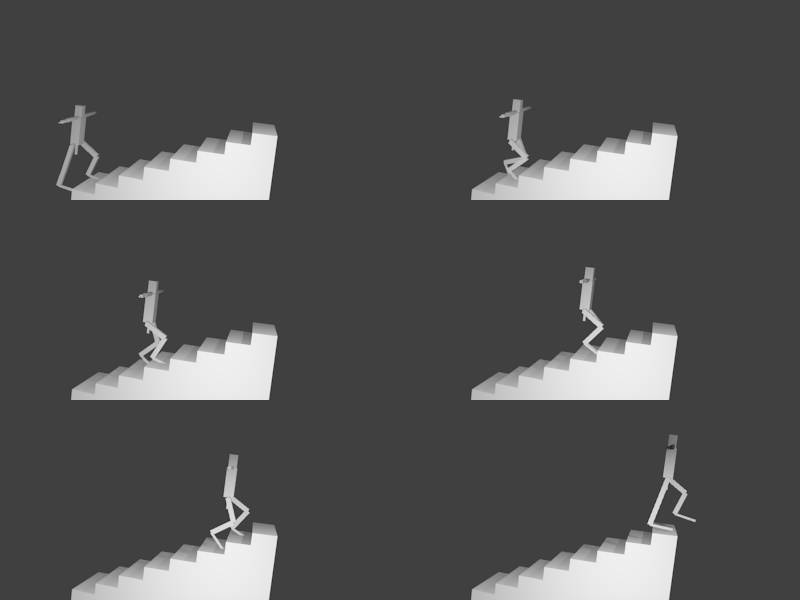
Fem grundläggande linjer
Upplevelsen av de fem linjerna är dynamisk och föränderlig, vanemässig och helt beroende av tyngdkraftens inverkan
[The experience of the five lines is dynamic and changeable, habitual, and entirely dependent on the influence of gravity.]
| Avsnitt | Tema |
|---|---|
1 A | Streckgubbar |
1 B | Fem linjer |
2 A | Gånganalys |
2 B | Löpteknik |
| Avsnitt | Tema |
|---|---|
3 | Bild blir filmrutor |
4 | Visshet om de egna linjerna |
5 | linjerna av en stålboll som rullar |
Avsnitt 1
En streckgubbe är en förenklad bild av en verklig eller fantasi person ritad endimensionellt (utan utbredning i rummet) förutom det runda huvudet som är tvådimensionellt.
"A stick figure is a simplified drawing of a real or imaginary person drawn one-dimensionally
(without spatial extension) except for the round head which is two-dimensional."
Det räcker med fem linjer för att vi ska uppfatta figuren. Ibland fäster armarna och benen direkt på bållinjen, ibland ritas skuldror och bäcken ut. Är armarna krokiga uppfattar vi armarna som böjda, om benlinjerna krokas uppfattar vi knän. Händer och fötter är ibland utritade men är inte nödvändiga för grundförståelsen av figuren. Inte ens huvudet behövs.
En liknande bild bestående av fem linjer representerar en del av självbilden.
På engelska används benämningen cardinal lines eller essentiell lines . Det kan uttryckas som huvudsakliga eller huvudlinjer samt grundläggande och livsviktiga linjer. Dessa linjer ligger djupt inbäddade i varseblivningen och självuppfattningen.
När vi till exempel ser en människa uppfattar vi fem grundläggande skelettlinjer. Bålen inklusive huvudet, armarna och benen. Vi uppfattar om personen kommer emot oss eller avlägsnar sig. Vi kan även tolka vad vederbörande gör. I en streckgubbe är linjerna raka och schematiska. Bållinjen är i verkligheten böjda, i kurvor och motkurvor som buktar åt olika håll. Det raka är undantag.
Det är möjligt att föreställa sig och känna efter dessa fem linjer närhelst i oss själva. Det ger medvetenhet.
Du vet i grova drag vilken hållning du har när du sitter och läser detta.
Stanna upp och känn efter.
Sitter du med benen i kors vet du det. Du vet om en eller båda fötterna är i golvet eller om det trycker mer på det ena sittbenet. Du vet om du håller huvudet på sned eller vänder ena örat eller ögat framåt. Du vet om armarna är raka eller böjda eller om du har dem korsade. Med lite uppmärksamhet vet du hur du håller händerna. Tummarnas och fingrarnas position. Svårare är att följa bållinjen eller ryggradens böjningar. Att uppfatta en enstaka kotas position är svårt. Den medvetenhet som efterfrågas för en feldenkrais process synliggör de fem linjerna med full uppmärksamhet och full urskiljning.
Dessa fem linjer ingår i självbilden som i sin tur föregår handlingsbilden. I handling är det dessa linjer som utgör förutsättningen för allt vi gör och är – och att vi kan vara medvetna kring detta. Linjerna är basen i den biologiska hållningen.
I feldenkraissystemet är uppmärksamhet av linjerna och dess förändring ett aktivt redskap för lärandet. Ibland finns en upplevelse att det förändras av sig själva under lektionen. Men de är även rättesnöre för justering och självkorregering.
Sätts flera bilder ihop i ordningsföljd till en film kallas det animation och det går att uppfatta ett händelseförlopp och hur figuren rör sig. Men det räcker med en figur för att få ett hum om vad den gör. Det finns även en allmänmänsklig samstämmighet att tolka figuren som ligger vid sidan av de olika kulturerna. Det är något vi känner igen och det är djupt förankrat i sinnet/hjärnan. Med djupt avses grundläggande, tidigt eller primitivt. Det går även att förstå en figur med fingertopparna om känselsinnet används istället för synsinnet.
English with Co-pilot
A stick figure is a simplified drawing of a real or imaginary person, drawn one-dimensionally (without spatial extension) except for the round head, which is two-dimensional.
It takes just five lines for us to perceive the figure. Sometimes the arms and legs attach directly to the torso line, sometimes shoulders and pelvis are drawn. If the arms are crooked, we perceive them as bent; if the leg lines are crooked, we perceive knees. Hands and feet are sometimes drawn but are not necessary for the basic understanding of the figure. Not even the head is needed.
A similar image consisting of five lines represents a part of the self-image. In English, the terms "cardinal lines" or "essential lines" are used. These can be expressed as main or principal lines, as well as fundamental and vital lines. These lines are deeply embedded in perception and self-awareness.
For example, when we see a person, we perceive five basic skeletal lines: the torso including the head, the arms, and the legs. We perceive whether the person is coming towards us or moving away. We can also interpret what the person is doing. In a stick figure, the lines are straight and schematic. The torso line is actually curved, with curves and counter-curves bulging in different directions. The straight line is an exception.
It is possible to imagine and feel these five lines within ourselves at any time. This brings awareness.
You roughly know your posture as you sit and read this. Pause and feel it. If you are sitting with your legs crossed, you know it. You know if one or both feet are on the floor or if there is more pressure on one sitting bone. You know if you are tilting your head or turning one ear or eye forward. You know if your arms are straight or bent or if you have them crossed. With a little attention, you know how you are holding your hands, the position of your thumbs and fingers. It is harder to follow the torso line or the curves of the spine. Perceiving the position of a single vertebra is difficult. The awareness required for a Feldenkrais process makes the five lines visible with full attention and full distinction.
These five lines are part of the self-image, which in turn precedes the action image. In action, these lines form the basis for everything we do and are – and we can be aware of this. The lines are the foundation of biological posture.
In the Feldenkrais system, attention to the lines and their changes is an active tool for learning. Sometimes there is an experience that they change by themselves during the lesson. But they are also a guideline for adjustment and self-correction.
If several images are put together in sequence to form a film, it is called animation, and it is possible to perceive a sequence of events and how the figure moves. But one figure is enough to get an idea of what it is doing. There is also a general human consensus to interpret the figure that transcends different cultures. It is something we recognize and it is deeply rooted in the mind/brain. By deeply, it means fundamental, early, or primitive. It is also possible to understand a figure with the fingertips if the sense of touch is used instead of sight.
Avsnitt 2
Feldenkraispedagog Andrew Gibbons demonstrerar sin gånganalys.
Och här Usian Bolts effektiva löpteknik
Avsnitt 3
Många människor förknippar uppmärksamhet kring sig själva i kroppslig bemärkelse som en fråga om muskler och hur muskler aktiveras, tränas, stärks och tänjs. Det är vad jag kallar ett anatomiskt förhållningssätt.
Men vi vet sedan John Hughlings Jacksons (1835 -1911) dagar att hjärnan inte fungerar utifrån enskild muskelaktivitet utan det är handlingen som räknas. Ja, vi kan som en kognitiv färdighet observera vad vi tror är en enskild muskel som aktiveras men det är ett starkt begränsat synsätt.
Om vi sitter på gymmet och drar i en apparat för att böja upp underarmen så kan vi kalla det bicepsträning men det är oändligt många fler muskler som håller oss upprätta på bänken… Jag brukar ställa frågan om vi tittar efter fotbollsspelarnas muskelarbete när det 22 spelarna rör sig över planen eller om det som vi läser in i spelet är en uppfattning om linjer som rör sig.
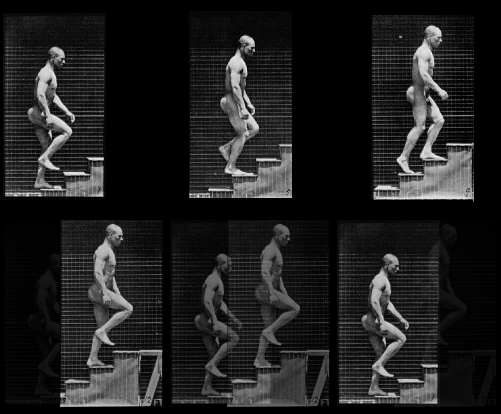
Vi är i dag vana att se rörliga bilder. Det finns två pionjärer på området. Étienne-Jules Marey (1830-1904) och Eadweard Muybridge (1830-1904). [De levde faktiskt under samma årtal och influerade naturligtvis varandra!] De tog bilder med flera kameror och satte ihop dem. Idag har man även satt ihop dem i filmsnuttar. Det är lätt att följa linjerna eller hur?
Eadweard Muybridge har en egen del av hemsida där du kan fördjupa dig än mer i hans pionjärarbete. Länk[+]
English with Co-pilot
Many people associate attention to themselves in a bodily sense as a matter of muscles and how muscles are activated, trained, strengthened, and stretched. This is what I call an anatomical approach.
But we have known since the days of John Hughlings Jackson (1835-1911) that the brain does not function based on individual muscle activity; it is the action that counts. Yes, we can, as a cognitive skill, observe what we believe is an individual muscle being activated, but this is a very limited perspective.
If we are at the gym pulling on a machine to bend the forearm, we can call it bicep training, but there are infinitely many more muscles that keep us upright on the bench... I often ask whether we look at the muscle work of football players when the 22 players move across the field, or if what we perceive in the game is a perception of lines moving.
Today, we are used to seeing moving images. There are two pioneers in the field: Étienne-Jules Marey (1830-1904) and Eadweard Muybridge (1830-1904). [They actually lived during the same years and naturally influenced each other!] They took pictures with multiple cameras and put them together. Today, they have also been compiled into film clips. It's easy to follow the lines, isn't it?
Eadweard Muybridge has his own section of the website where you can delve even deeper into his pioneering work.
Avsnitt 4
Livet kräver vissheten om var de egna linjerna är - i nuet.
Var och en och alla samtidigt
Life requires the certainty of where one's own lines are - in the present.
Each and every one simultaneously.